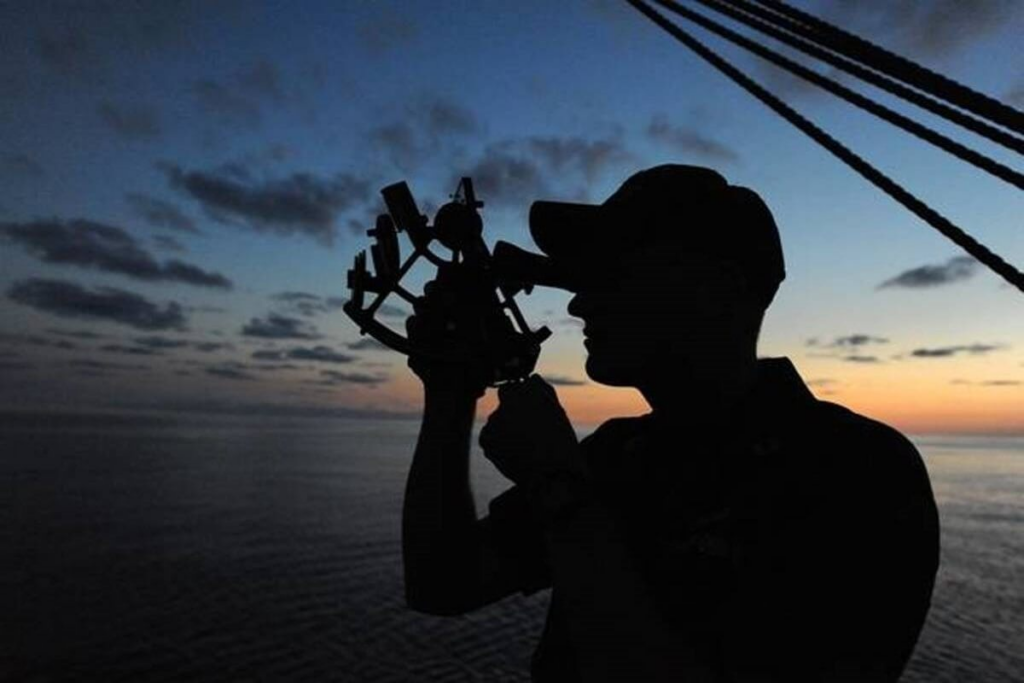
Cette série de douze textes développe les techniques nécessaires pour faire de la navigation astronomique. Ils comprennent des exemples et des applications, permettant d’apprendre via des exercices. En préalable, il faut être à l’aise avec les calculs fondamentaux utilisés en navigation. En particulier, il faut bien comprendre les systèmes de coordonnées et savoir additionner ou soustraire des coordonnées mesurées en degrés, minutes et secondes.
La théorie de navigation astronomique se comprend en une heure ou deux. Les idées sont simples. Après avoir lu le deuxième texte, vous comprendrez pourquoi la technique fonctionne.
L’application de la technique requiert cependant des calculs et, en débutant, beaucoup de patience! Si on ne porte pas attention aux détails, on peut facilement faire des erreurs. Il faut d’abord prendre son temps, puis, une fois qu’on comprends bien la recette, faire les choses plus rapidement.
Il est préférable de lire ces textes dans l’ordre. Cependant, après le texte portant sur l’identification du pied d’un corps céleste, on peut faire la première application, soit faire un point midi (noonsight).
- Exercices de réduction avec formules trigonométriques.
- Exercices de réduction avec table de réduction.
Cette série vous a plu? Vous pouvez en lire d’autres dans la section Apprendre de ce site.

28 Responses
[…] Navigation astronomique […]
[…] Navigation astronomique […]
[…] Navigation astronomique […]
[…] Navigation astronomique […]
[…] Navigation astronomique […]
[…] Navigation astronomique […]
[…] Navigation astronomique […]
[…] Navigation astronomique […]
[…] Navigation astronomique […]
[…] Navigation astronomique […]
[…] Navigation astronomique […]
[…] Navigation astronomique […]
[…] Navigation astronomique […]
[…] Navigation astronomique […]
[…] is the first in a series of articles on celestial navigation. It covers the tools and documents required for celestial navigation, […]
[…] is the second in a series of articles on celestial navigation. It sets out the theory needed to understand how the technique works. The focus is on understanding, […]
[…] using circles of position centred on the GP of a celestial body. This fifth article in the series on celestial navigation shows how to find the GP of any celestial body. This is an intermediate step used to determine our […]
[…] text is the sixth in a series on celestial navigation. It focuses on the method for converting sextant readings into a position line, i.e. a reduction of […]
[…] Here is a series of five reduction exercises based on sextant observations, using spherical trigonometry. To understand how to complete these exercises, you will need to have read the text on reducing sextant observations or, more generally, the series of texts on celestial navigation. […]
[…] This text contains sight reduction exercisesusing the Ho 249 reduction tables. Beforehand, you should read the text on sextant observation reduction or, more generally, the series of texts on celestial navigation. […]
[…] text is the fourth in the series on astronomical navigation. It deals with the corrections to be made to observations taken with a sextant. The text on how to […]
[…] is the third in a series of articles on celestial navigation. It focuses on the use of the sextant. Specifically, it covers how […]
[…] seventh article in the series on astronomical navigation focuses on plotting position lines. This is the easiest part – and usually the last – of a […]
[…] article is the ninth in a series on celestial navigation. It explains how to take a noon sight. Before reading this, you should have a good grasp of the […]
[…] is the eighth in a series of articles on celestial navigation. It answers a key question: when should you take your celestial observations and which stars should […]
[…] eleventh text in the series on celestial navigation covers the use of solar observations to determine the compass deviation associated with a course. […]
[…] text is the tenth in the series on celestial navigation. It covers how to convert three star sightings into three position lines, enabling you to determine […]
[…] text is the last in the series on celestial navigation. It applies the material developed in the previous texts to determine a position from two […]