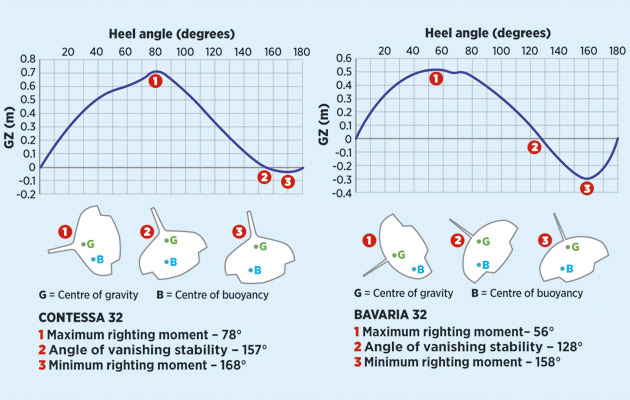
Do the Contessa 32s comply with the criteria of the International Code on Intact Stability, 2008? In other words, are they stable sailing yachts according to international merchant shipping standards? The short answer is yes.
Here are the Code’s criteria:
- The area under the righting lever curve (GZ) should not be less than 0.055 metre-radians up to an angle of 30° heel.
- The area under the righting lever curve (GZ) should not be less than 0.09 metre-radians up to an angle of heel of 40°, or the angle of flooding, if that angle is less than 40°.
- The area under the curve between 30° and 40° or between 30° and the angle of flooding (if this is less than 40°) should not be less than 0.03 metre-radians.
- The righting lever should be at least 0.2 m at an angle of heel of 30° or more.
- The maximum righting lever should preferably be beyond an angle of 30°, but not less than 25°.
- The initial metacentric height (GM0) should not be less than 0.15 m.
We examine these below, one by one.
Criteria 1, 2 and 3
The values below are taken from the graphs at the start of the text. They can be used to calculate the area under the curve from 0 to 30° and from 0 to 40° using Simpson’s rule.
| Heel angle | 0° | 10° | 20° | 30° | 40° |
| GZ | 0 | 0.15 | 0.30 | 0.41 | 0.50 |
Criterion 1
The area under the GZ curve can be approximated using Simpson’s ‘3/8’ weighting:
| Heeling angle | 0° | 10° | 20° | 30° |
| GZ | 0 | 0.15 | 0.30 | 0.41 |
| Simpson’s weight | 1 | 3 | 3 | 1 |
| Weighted value | 0 | 0.45 | 0.9 | 0.41 |
The sum of the weighted values is 1.76 m°. An approximation of the area under the curve can be obtained by multiplying by 30/8, giving 6.6 m°. To express this in metre-radians, we must multiply by 2π and divide by 360. This gives a value of 0.115 metre-radians, which is greater than the criterion of 0.055 metre-radians.
Criterion 2
We use the same approach, but this time with Simpson’s rule, known as the ‘1/3’ rule.
| Heel angle | 0° | 10° | 20° | 30° | 40° |
| GZ | 0 | 0.15 | 0.30 | 0.41 | 0.50 |
| Simpson’s weight | 1 | 4 | 2 | 4 | 1 |
| Weighted value | 0 | 0.6 | 0.6 | 1.64 | 0.5 |
The sum of the weighted values is 3.34 metre-degrees. To obtain an approximation of the area under the curve, we multiply by 10/3 to get 11.13 metre-degrees. To obtain the result in metre-radians, we must convert the value by multiplying by 2 times pi and dividing by 360. This gives 0.1943 metre-radians, which is greater than the required value of 0.09 metre-radians.
Criterion 3
We can calculate the difference between the two values to get 0.07 metre-radians (0.1943 – 0.115), which is greater than the required value of 0.03 metre-radians.
Criteria 4 and 5
Criteria 4 and 5 can easily be met by examining the stability curve: the righting lever is at its maximum at an angle of 80°, with a value of approximately 0.7 m.
Criteria 6
We know that for small angles, the value of GZ is given by the approximate formula:
We can therefore work out the value of GM by calculating GZ at an angle of 10°. This gives an initial GM of 0.86 m, which is well above 0.15 m.
Conclusion
The Contessa 32s meet the criteria for intact stability of vessels. This exercice does not reveal much for sailboats, and is more academic than anything else. A fact far more revealing of their endurance is how they fared in the 1979 Fastnet race...