In developing a theory of celestial navigation, we have seen that a ship’s position is determined using circles of position centred on the GP of a celestial body. This fifth article in the series on celestial navigation shows how to find the GP of any celestial body. This is an intermediate step used to determine our position.
A celestial body is any celestial object that can be used to establish a position. It may be a star, notably the Sun, but also a planet in the solar system or even the Moon. It is a generic term for any object used to take a reading with a sextant.
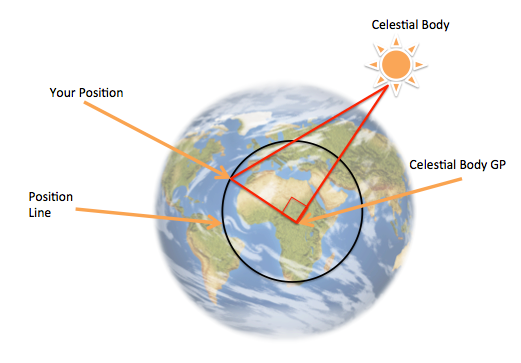
The GP a celestial body is the position on Earth directly beneath that body. If a straight line is drawn between the star and the centre of the Earth, then the point on the Earth’s surface where this line intersects is the GP of the celestial body.
To help understand this, any observer standing at the GP of a celestial body would see that body directly overhead. Similarly, a sextant observation taken at the GP of a celestial body would give an altitude (an angle) of 90° relative to the horizon. In the image below, the GP of the star is at the centre of the circle.
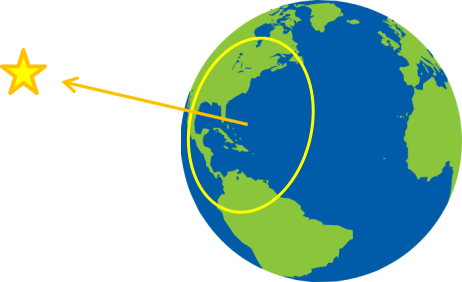
Because the Earth rotates and because certain bodies (the Moon, Sun, planets) move through space, the GP of a celestial body moves constantly. Even the stars, which we assume to be fixed, move at a rate of 15° per hour due to the Earth’s rotation.
We are interested in the GP of a celestial body in order to establish a circle of position. In doing so, we are interested in finding the GP at the moment we take our sextant reading. In practice, it is crucial that every sextant observation is meticulously recorded with a precise time (to the nearest second!). This time will allow us to determine the position of the celestial body’s GP.
The calculations required to find this information involve addition, subtraction and interpolation. The only subtlety with addition and subtraction is that we are working with degrees and minutes. If necessary, you can review the relevant sections of the fundamentals of navigational calculations concerning conversions and interpolation.
Finding the GP of a celestial body
It is the almanacs that provide us with the position of a celestial body in tabular form. Positions are given hourly, but not to the nearest second. Consequently, interpolation calculations are required to find the position at a precise moment.
The information in almanacs is given in Greenwich Mean Time (GMT 0). We must therefore ensure that the time at which we took our sextant measurement is converted to account for the time zone difference.
Almanacs encode the GP of celestial bodies in the solar system (planets, Sun, Moon) differently from that of stars. This difference stems from the fact that the planets, the Sun and the Moon, unlike the stars, move within the solar system. As there are two methods for encoding the position of a celestial body, the two approaches are discussed separately in the following two sections.
Finding the GP of a body in the solar system
For the Moon, the Sun and the planets, almanacs provide the coordinates of the celestial body’s position directly. The coordinates are given in terms of Greenwich Hour Angle (GHA) and declination.
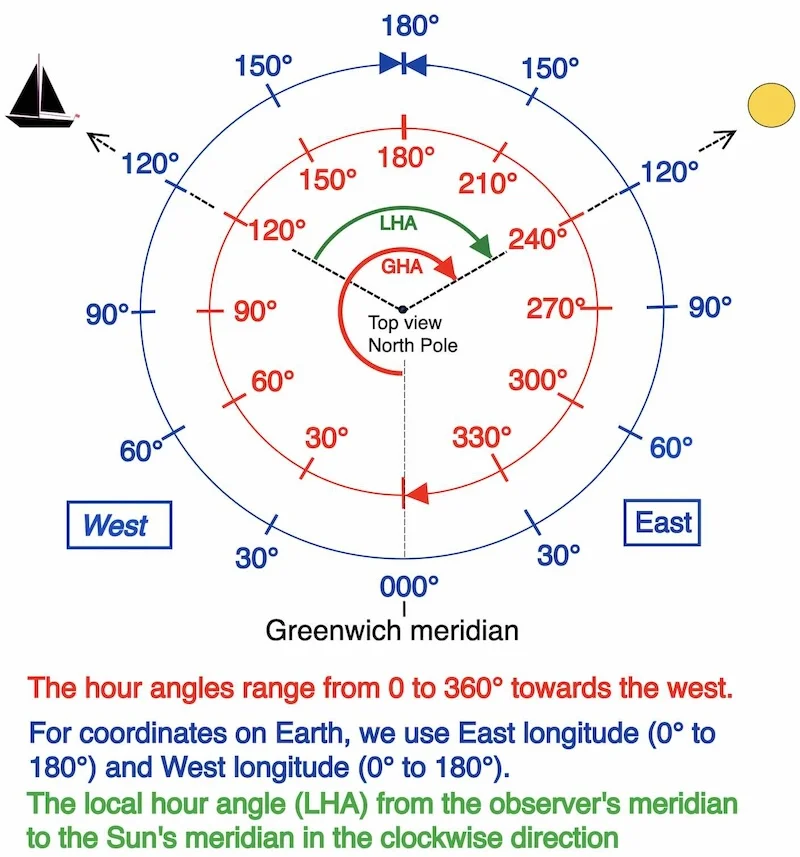
Greenwich Hourly Angle (GHA) is equivalent to longitude, with the exception that angles range from 0 to 360°, moving westwards from the Greenwich meridian. Thus, the first 180° of Greenwich Hourly Angle are equivalent to 180° west longitude. However, the 181st degree and beyond are equivalent to counting east longitude in reverse (left-hand image).
As for declination, it is strictly equivalent to latitude, ranging from 90° South to 90° North. It conveys the same information. Its use is, however, restricted to celestial bodies.
Once these concepts are understood, the recipe below can be used to calculate the GP of a celestial body in the solar system.
- Convert the time of our sextant measurement to Greenwich Mean Time.
- From the Almanac, obtain the position of the celestial body at the full hour preceding the time of the measurement.
- Apply the GHA correction by interpolation.
- Apply the declination correction by interpolation.
The procedure is applied in the examples below. Before attempting them, it is helpful to learn how to read the GHA and declination data correctly from the Almanac.
Reading the GHA and declination of a celestial body
The table below provides an extract from the Almanac showing the position of the Sun and the Moon for 1 January 2026. The information is provided for whole hours.
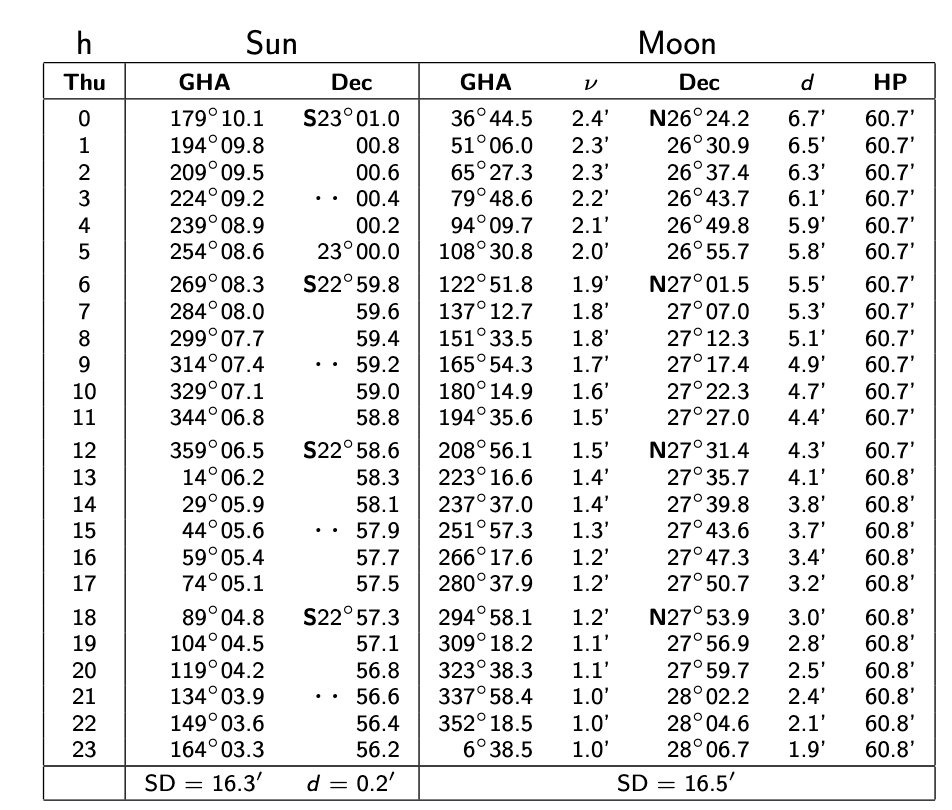
One should be able to deduce that the position of the Sun at 0000 (midnight) Greenwich Mean Time is a GHA of 179° 10.1′ and a declination of S23° 01.0′ (S for ‘South’). This information is contained in the first row of the table named ‘Sun’, in the ‘GHA’ and ‘Dec’ columns respectively. Similarly, the position of the moon at 0600 Greenwich Mean Time is given by a GHA of 122° 51.8′ and a declination of N27° 01.5 (N for ‘North’).
Note that for some declination entries, the whole degrees are not repeated. It is important to understand that the last entry above the time of interest is the one to note. For example, the declination of the Sun at 19:00 (Greenwich Mean Time) is 22° 57.1′ north. It is 22° 56.8′ north at 20:00, and so on.
One should be able to read this table for any given time. The declination of the planets is presented in a similar way (not shown), and one should also be able to extract the position hour by hour for each of them. This is the strength of the Almanac: one simply needs to read the table. Before proceeding to the next steps, it is good practice to check that one has the correct date, the correct time, the correct celestial body and the correct figures.
First example
On 6 June 2026, we took a sextant reading of the Sun of 55° 45.4′. This reading was taken at 10:35:06, Quebec Daylight Time. Where is the Sun’s GP?
Step 1
It is 10:35:06 am, daylight saving time, meaning we have added one hour compared to the standard time zone. It is therefore 09:35:06 am without the daylight saving time correction. Because Quebec is in the UTC-5 time zone (five hours ahead of Greenwich), we must add 5 hours to obtain the time in Coordinated Universal Time (UTC 0). It is therefore 14:35:06 on the same day, Greenwich Mean Time.
Step 2
We need to identify the page in the Almanac corresponding to 6 June 2026. The relevant extract is reproduced below.
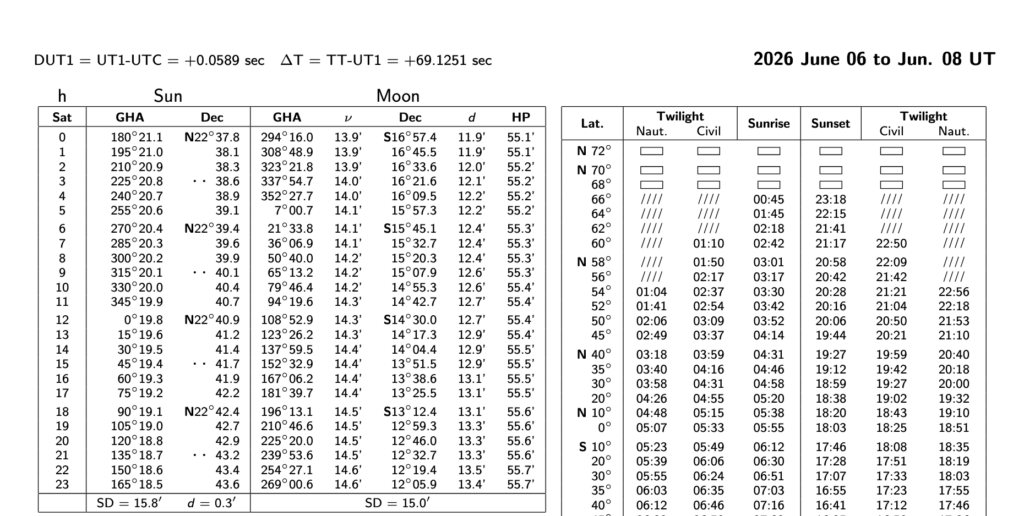
We are looking for the full hour preceding the observation, i.e. 14:00. Reading the table for the sun, we obtain a GHA of 30° 19.5′ and a declination of 22° 41.4′ north. This would be the position of the sun at 10:00 am Quebec daylight saving time, but this time does not correspond to when we took our reading. We must make the appropriate corrections of 35 min 06s to obtain the exact coordinates.
Step 3
There are two ways to make the necessary correction to obtain the position of the celestial body at a given time:
- You can use the correction table at the end of the Almanac;
- You can interpolate directly from the table entries.
Both lead to the same result (give or take a rounding error), so ‘the right method’ is more a matter of personal preference than anything else. To help you decide, the first approach requires fewer calculations but increases the risk of making errors when reading the tables in the Almanac. It is up to you to judge which approach fits you better. For the first example, I will use both approaches.
First method
At the end of the Almanac (pages 261 onwards in the 2026 edition), there are tables entitled ‘Increments and Corrections’, which calculate the interpolations for us for each celestial body. In the example, we are 35 minutes and 6 seconds past the hour, so we need to look up the page for 35 minutes, then read the table entry for the Sun, in the row corresponding to 6 seconds. The relevant extract from the table is reproduced below (page 272). For the Sun (or for a planet), we thus note a correction of 8° 46.5′.
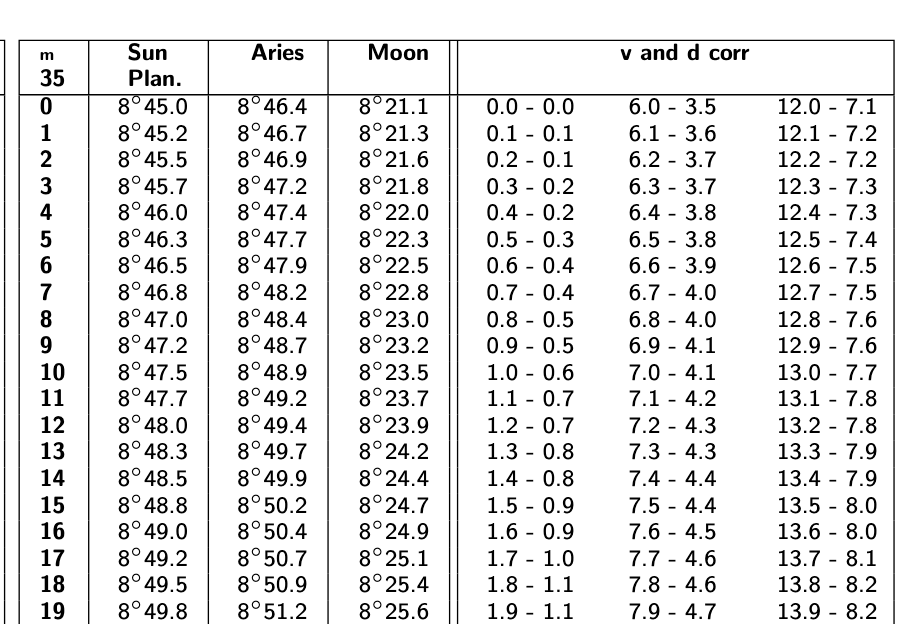
We must therefore add 8° 46.5′ to the GHA obtained for 14:00, bearing in mind that there are sixty minutes in a degree. The calculation thus gives 30° 19.5′ 8° 46.5′ = 39° 6.0′. The GHA of the Sun is therefore 39° 6.0′ at 14:35:06.
Second method
Between 1400 and 1500, the Sun’s GHA changes from 30° 19.5′ to 45° 19.4′, a difference of 14° 59.9′. We must determine the change in this difference over 35 minutes 6 seconds by interpolation. The 35 minutes 6 seconds correspond to 0.585 hours. Applying this ratio, we find a change of 8.774°, or 8° 46.4′. This must then be added to the GHA obtained at the full hour, giving 39° 5.9′ at 14:35:06.
(Note that there is a difference of one-tenth of a minute in the GHA.)
Step 4
We apply the same principle to the declination. There are two methods, but I find one better because it is more accurate:
- Use the correction d at the end of the celestial body’s declination table and perform a rule of three.
- Interpolate the correction directly from the positions in the table. (better!)
I illustrate both approaches below.
First approach
The correction d is 0.3′ and corresponds to the average variation in declination over one hour. For example, the variation in the Sun’s declination between 14:00 and 15:00 is indeed 0.3′ on 6 June 2026, but may vary slightly from one hour to the next (see between 01:00 and 02:00 on the same day).
We apply a rule of three to account for the movement of 35 minutes and 6 seconds. These 35.1 minutes correspond to 0.585 hours. Thus, the sun’s displacement, in terms of declination, is 0.1775′ (0.585 × 0.3), which can be rounded to 0.2′. Therefore, the sun’s declination is 22° 41.4′ – 0.2 = 22° 41.6’N.
Second approach
The angular difference in declination between 1400 and 1500 is 0.3′. Applying the rule of three from the previous section, we obtain the same answer.
The advantage of the second approach is that it is slightly more accurate when the average deviation does not correspond to the current hour deviation.
Summary
On 6 June 2026, at 10:35:06 am Quebec time, the GP of the sun is at GHA 39° 5.9′, Dec 22° 41.6’N.
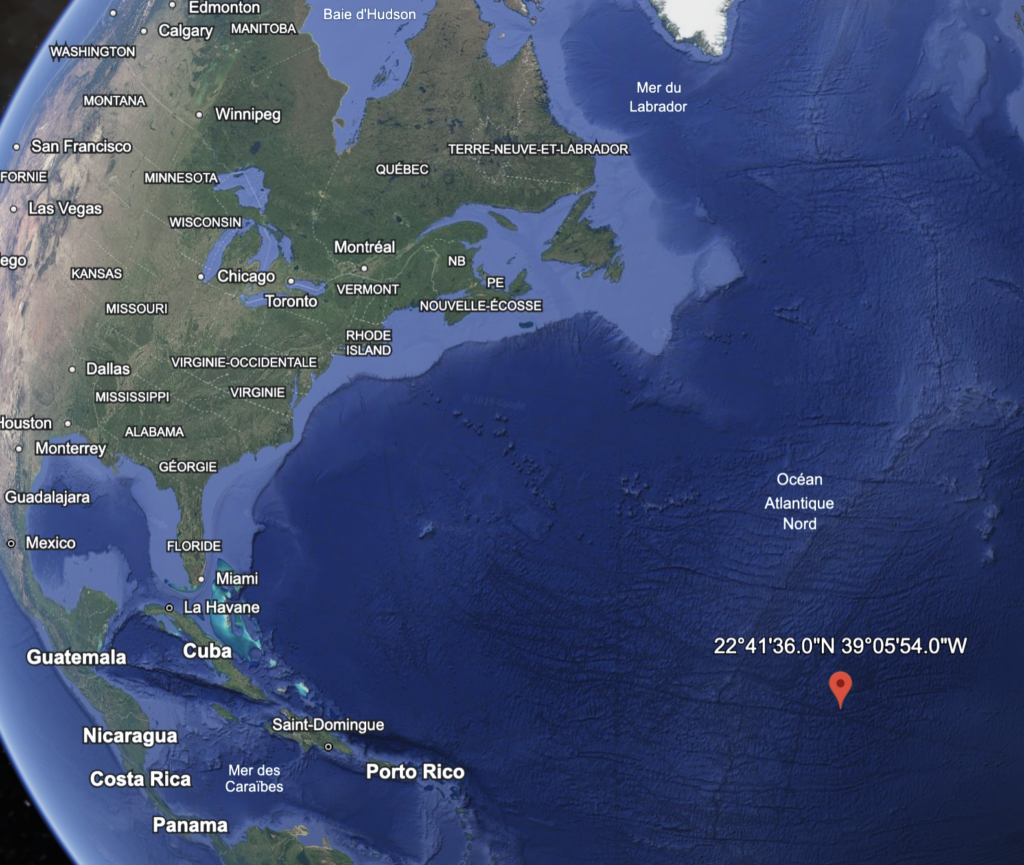
For celestial navigation calculations, it is not standard practice to convert these coordinates into latitude and longitude, but to help us understand the correspondence, we can note that the GHA is less than 180° and therefore corresponds to a longitude of 39° 5.9′ W. The declination, meanwhile, corresponds to a latitude of 22° 41.6’N. This coordinate corresponds to a point somewhere in the Atlantic (image below). We know that at this time, the Sun would be directly overhead if we were at that point.
Second example
On 4 July 2026, you take a sextant reading of the planet Saturn and obtain an observed altitude (angle) of 30° 55.4′. You took your reading at 23:41:54 Quebec Daylight Time. What is Saturn’s GP at this time?
Step 1
You must apply the correction for daylight saving time (-1h) and then convert to Greenwich Mean Time (GMT) (5h). This gives 23 – 1 5 = 27h41m54s. Since this exceeds the 24 hours of a day, it means it is one day later at the Greenwich meridian. We must therefore add one day and subtract 24 hours to obtain 03h41m54s on 5 July 2026 at Greenwich.
This example illustrates that time zone differences can change the day with timezone conversions.
Step 2
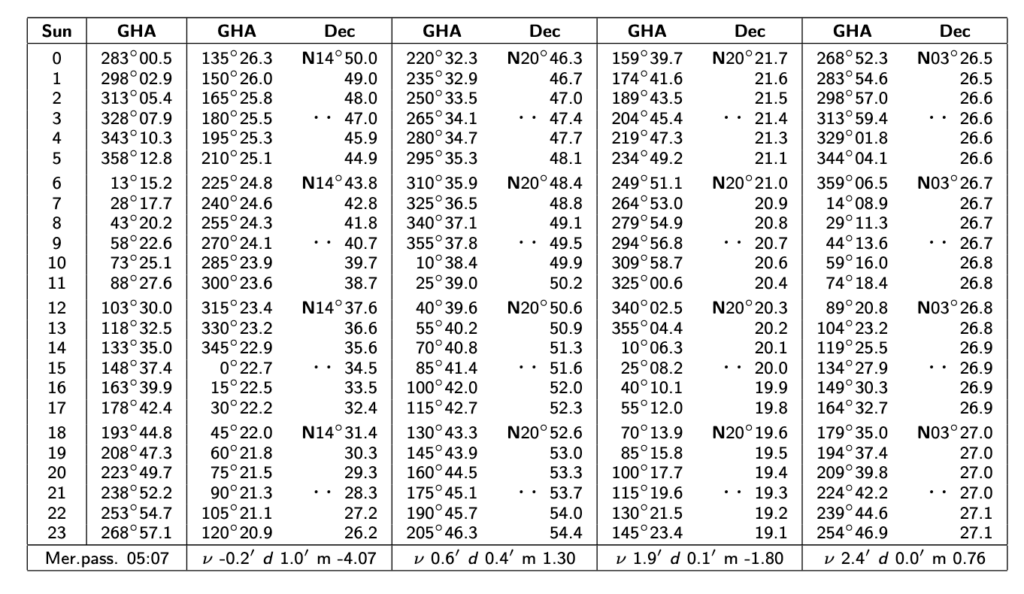
We need to consult the Almanac for 5 July 2026 and look at the table listing the values for Saturn. The relevant extract is reproduced below. The last column corresponds to Saturn.
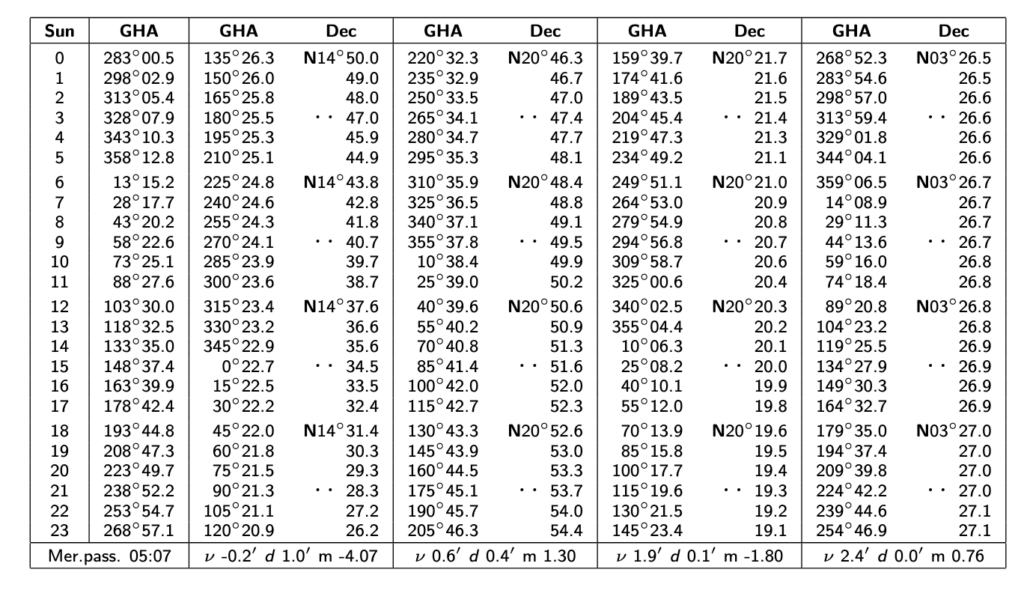
At 0300, the GHA is 313° 59.1′ and the declination is 03° 26.6’N.
Step 3
Between 0300 and 0400, there is an angular difference of 15.04° in the Greenwich Hour Angle. Applying a rule of proportion to the 41 minutes 54 seconds difference, we obtain a correction of 10.5°, or 10° 30.0′. Saturn’s GHA is therefore 313° 59.1′ 10° 30.0′ = 324° 29.1′.
Step 4
Between 0300 and 0400, there is an angular difference of 0′ in declination. Saturn’s declination does not need any correction, and is therefore 03° 26.6’N.
Summary
Saturn’s position is given by a GHA of 324° 29.1′ and a declination of 03° 26.6’N at 23h41m54s on 4 July 2026 (Quebec Daylight Time).
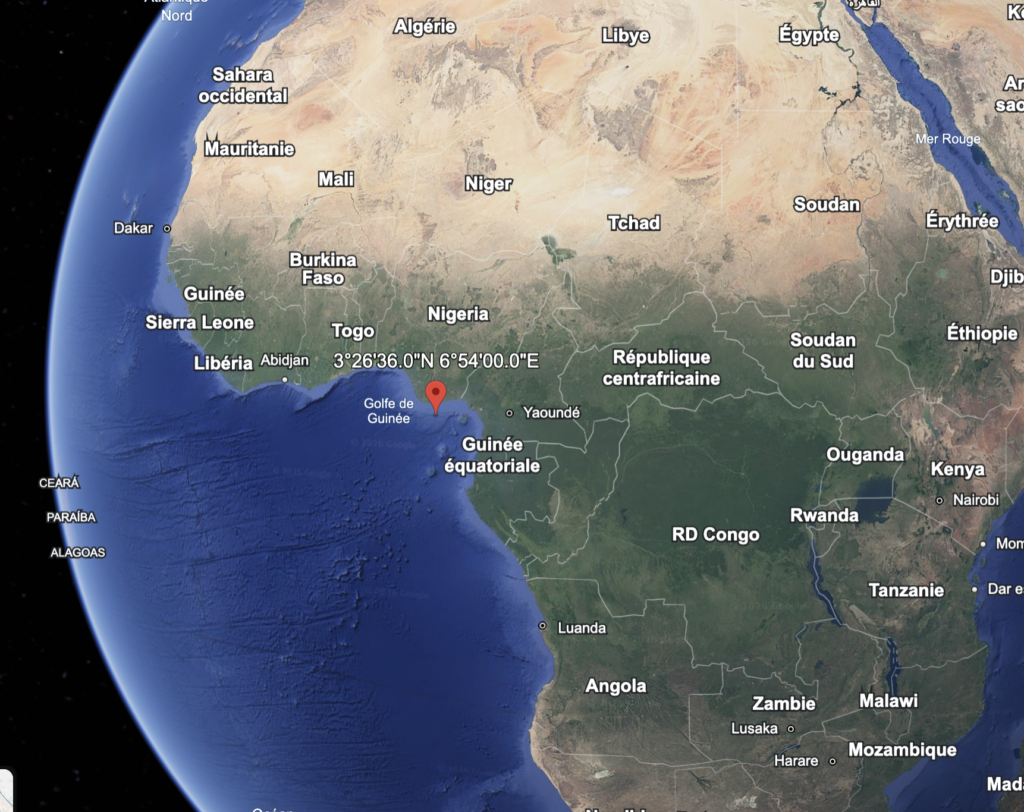
This is not necessary for standard astronomical navigation calculations, but if you wish to convert this position to longitude and latitude, you can do so. The GHA is 324° 29.1′ and therefore corresponds to a longitude east of the Greenwich meridian. To find it, you must subtract the GHA from 360° to obtain 6° 54.0′ E. The latitude is, of course, equal to the declination, i.e. 03° 26.6′ N. The GP of Saturn is thus located somewhere south of Nigeria (image below).
Finding the GP of a star
For stars, almanacs provide the position of the point of aries (♈) hour by hour. Because stars are fixed relative to this point, one must then identify the relative angle between the star and the vernal equinox (i.e. the sidereal hour angle, SHA). This difference then allows us to determine the star’s position.
This approach requires a few calculations, but allows us to identify the position of any star whilst keeping the number of almanac pages to a minimum. An almanac typically comprises between 250 and 400 pages. If the position of each star were provided individually, the number of pages would have to be increased fivefold!
Although the objective is exactly the same as for the GP of a body in the Solar System, the information needed to find the position of a star is encoded differently in almanacs. Consequently, the method to be applied is different. It is detailed below.
- Convert the time of the observation to Greenwich Mean Time using the time zones.
- Obtain the Greenwich Hour Angle (GHA) of the point of Aries for the nearest whole hour from the almanac.
- Apply the correction to obtain the GHA at the exact time of the observation.
- Obtain the sidereal hour angle (SHA) of the star in question from the almanac.
- Calculate the GHA of the star.
- Obtain the star’s declination.
First example
On 4 July 2026 at 23:41:54 (Quebec Daylight Time), you take a sextant observation of the star Deneb at 78° 41.6′. Where is the star’s GP located?
Step 1
This is the same date and time as in the previous example (for Saturn). Consequently, this corresponds to 03:41:54 on 5 July 2026, Greenwich Mean Time.
Step 2
The GHA for the full hour is obtained by reading the ‘Aries’ column on the relevant page of the Almanac (p. 138 for the 2026 edition). At 0300, the vernal point has a Greenwich hour angle of 328° 07.9′.
(Note: as the celestial sphere lies in the same plane as the Earth’s equator, the vernal point always has a declination of 0° relative to the Earth).
Step 3
The angular difference of the vernal point between 0300 and 0400 is 15.04°. A correction of 41m54s corresponds to 10.5°, or 10° 30.0′. The GHA of the vernal point at the exact time of interest is thus given by 328° 07.9′ 10° 30.0′ = 338° 37.9′.
Steps 4 and 6
The sidereal hour angle (SHA) and the star’s declination are provided by the almanac on the same page as the information on the vernal point. The table below summarises the information for the 51 stars useful for navigation (p. 138 for the 2026 edition).
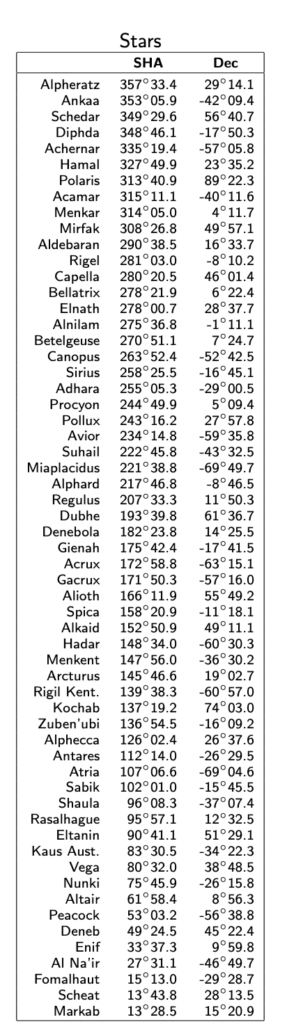
For Deneb, we see that the SHA is 49° 24.5′ and that the declination is 45° 22.4′. As the declination is positive (no ‘-’ sign before the number), this means that the declination is north. (By convention, a negative declination is south).
Step 6
In Step 3, we calculated the GHA of the vernal equinox. We also know that, in the celestial sphere coordinate system, the SHA is the angular distance of the star from the vernal equinox (Step 3). Consequently, if we add the two together, we will obtain the star’s GHA. The only additional caveat is that if this sum exceeds 360°, we must subtract 360° to account for the redundant full rotation in the coordinate system.
Thus, the ‘raw’ GHA of Deneb is 338° 37.9′ 49° 24.5′ = 388° 02.4′. This angle is greater than 360°, so we must subtract 360° to obtain: 28° 02.4′.
Summary
The position of Deneb’s GP is thus given by a GHA of 28° 02.4’ and a declination of 45° 22.4’ north. Although this is not necessary for astronomical navigation calculations, it corresponds to a longitude of 28° 02.4′ West and a latitude of 45° 22.4′ North. This GP is somewhere in the North Atlantic.
Second example
On 1 August 2026 at 21:37:50, Quebec Daylight Time, you take a sextant observation of the star Vega. Where is its GP?
Solution
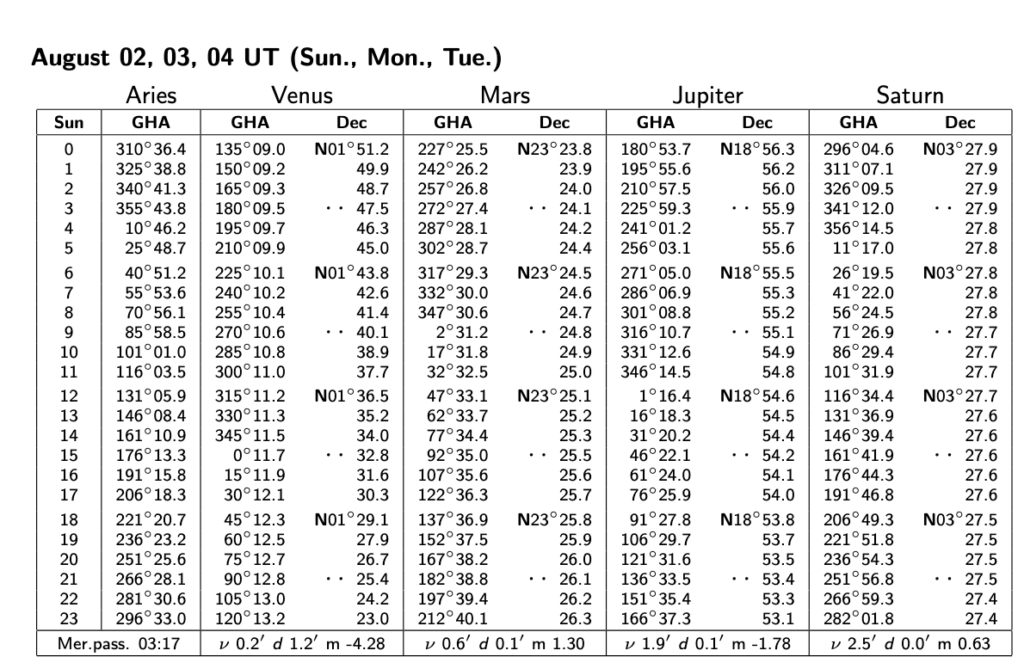
I will outline the steps in a single paragraph. The time of the observation corresponds to 01:37:50 on 2 August 2026 Greenwich Mean Time. From the Almanac (image below), we deduce that the GHA of the vernal point is 325° 38.8′ at 01:00. The correction required for the 37 minutes 50 seconds is 9° 29.1′ (15.042 × 0.6306). The GHA at the exact time is therefore 335° 7.9′.
Consulting the star table and looking at the entry for Vega (this is the same table as in the previous example, as the stars are fixed relative to the vernal equinox), we obtain an SHA of 80° 32.2′ and a declination of 38° 48.5′ N. Consequently, Vega’s GHA is 55° 40.1′.
In summary, the GP of Vega is at GHA 55° 40.1′ and a declination of 38° 48.5′ N.
Conclusion
Determining the GP of a celestial body is an intermediate step in calculating its position using astronomical observations. This must be done at the time when the sextant observation was taken.
In this text, the calculation of the GP is presented in a step-by-step manner, with separate stages. The aim is to make learning easier. In practice, this type of calculation is done on a notepad (image below).
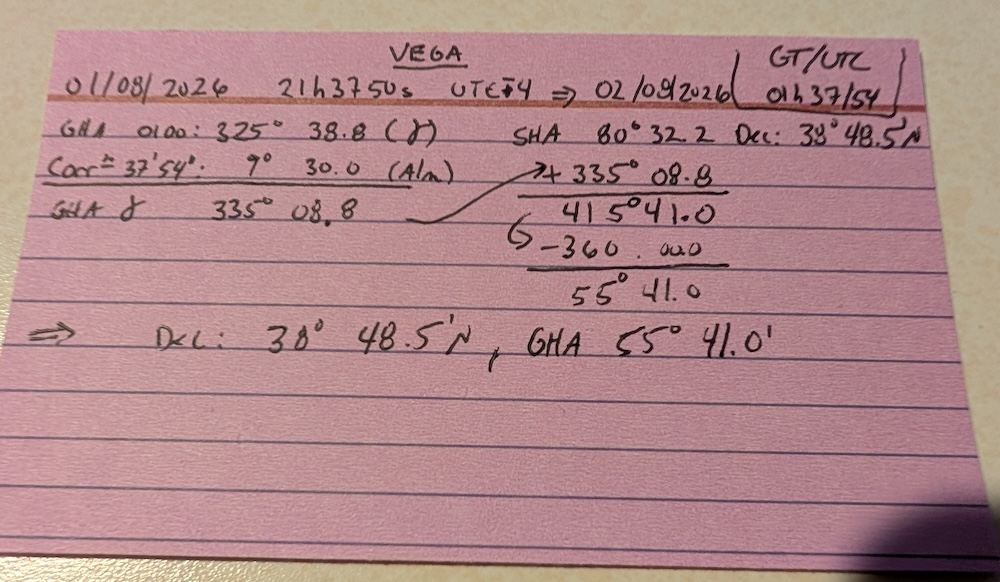
Although the steps to follow do not require knowledge of the theory behind the calculations, understanding this is invaluable for grasping what is happening and potentially spotting errors. It is good practice, when starting out, to try to interpret what these calculations mean.
The aim is to arrive at the GHA and declination without error. If you are doing these calculations for the first time, focus on your ability to arrive at the correct answers without error, then work on doing these calculations faster and faster. With practice, these calculations take less than a minute.
Determining your position using astronomical observations requires at least three sextant observations, which means you need to find at least three celestial bodies to determine a position. You therefore need to get used to doing them.
The aim of the next section is to establish a line of position from the celestial body’s position. There are two radically different approaches to doing this. The first requires the use of a calculator and trigonometric functions. The second requires only addition and subtraction. However, it requires 500 pages of tables to replace the formulas. Both approaches will be covered in the next text. In practice, choose whichever approach you prefer.
The other texts on astronomical navigation are in the Learn section of this site. Together, they will provide you with the essentials to be able to apply it.



3 Responses
[…] readings into a position line, i.e. a reduction of sextant observations. The text explaining how to find the GP of a celestial body should be read […]
[…] readings into a position line, i.e. a reduction of sextant observations. The text explaining how to find the GP of a celestial body should be read […]
[…] a sextant reading into a position line. The next article explains the technique for identifying the foot of a celestial body. The following article explains the technique for finding the position line associated with the […]