This text contains sight reduction exercisesusing the Ho 249 reduction tables. Beforehand, you should read the text on sextant observation reduction or, more generally, the series of texts on celestial navigation.
Exercise 1
Your estimated position is at 50° 18.7’N / 058° 23.89’W at 1825 UTC-3.5. The observed altitude H_o of the star Pollux is 33° 28.0’. The star’s GP is GHA 348° 05.1′ / Dec 27° 57.1 N. Identify H_c, Z, Z_n the distance to the estimated position, as well as the direction in which the actual position lies.
Solution
We must adjust our estimated position so that the latitude is a whole number and the longitude gives a whole GHA. The latitude of our estimated position therefore becomes 50°N. As our latitude is west and the GHA of Pollux is greater than the longitude, we simply need to subtract the two to obtain the LHA.
To obtain a whole number, and remain relatively close to our original estimated position, we must take 058° 05.1′ W. In doing so, the LHA becomes 348° 05.1′ – 58° 05.1′ = 290°. Our latitude and declination are both north.
In summary:
- Our new estimated position is at 50°N / 058° 05.1′ W.
- The LHA is 290°.
- The latitude and declination are of the same sign.
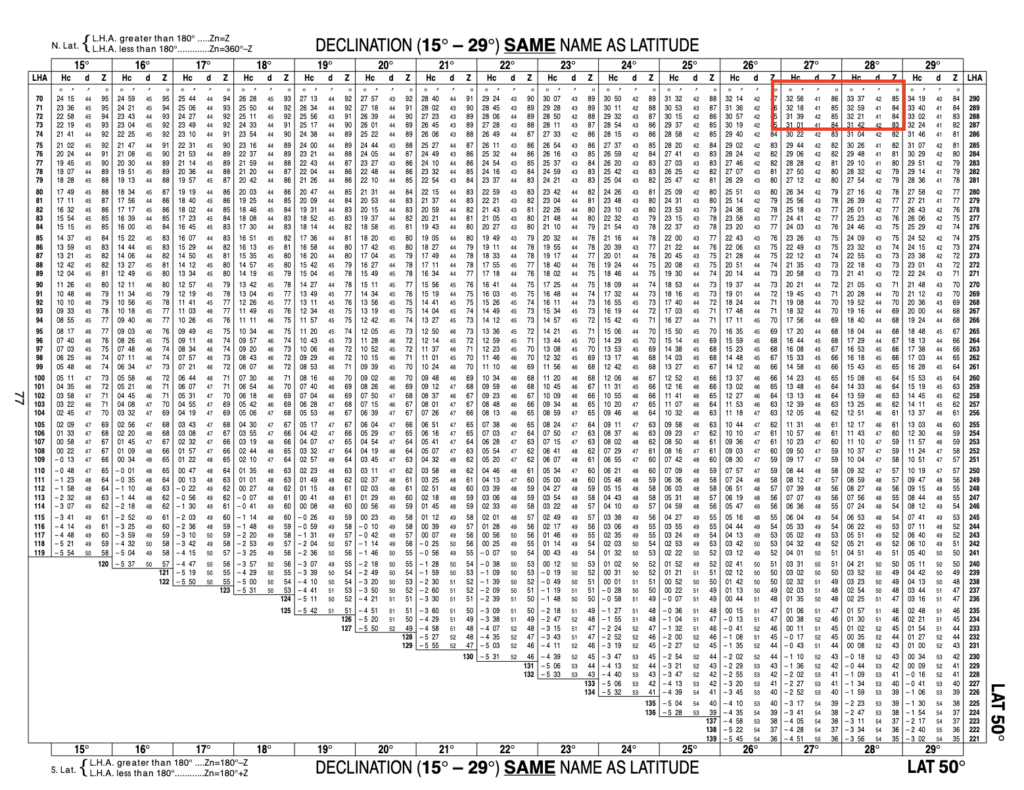
Page 77 of Volume 3 of the reduction table allows us to find the required information. For 27° declination, we find H_c =32° 56′ and Z = 86°. For a declination of 28°, we find H_c =33° 37′ and Z = 85°. As the actual declination lies between the two, we must interpolate.
The 57.1 minutes correspond to 95% of a degree. The difference between the two calculated altitudes is 41 minutes. Therefore, 95% of these 41 minutes corresponds to 39 minutes. The interpolated calculated altitude is therefore 32° 56′ 41′ = 33° 37′. By a similar calculation, Z = 85° 03′. As we are at a northern latitude and the LHA is greater than 180°, the azimuth is 85° 03′.
In short, if we had taken our sextant reading at the position 50°N / 058° 05.1′ W, the altitude we would have found would be 33° 37′. The altitude we observed is 33° 28.0’, a difference of 9 nautical miles. As our reading is smaller than the calculated reading, this means we are further from the GP of the celestial body than the estimated position. We therefore have the following information for our position line:
- The position line is 9 nautical miles from the position 50°N / 058° 05.1′ W.
- The direction of Pollux is 085°. As we are further away, the position line is moving away from the GP of Pollux (i.e. at 085 180 = 265°).
- The position line is perpendicular to the direction of the star’s GP.
Exercise 2
At 1200 UTC-3.5, you obtain an observed altitude H_o of the Sun of 26° 45.5’. Your estimated position is 47° 25’N / 60° 40’W and the GP of the Sun is GHA 41° 35.6’ / Dec 13° 32.8’S. Identify H_c, Z, Z_n the distance to the estimated position, as well as the direction in which the true position lies.
Solution
The new estimated position is 47°N / 60° 35.6′ W. From the ship’s position, the angular deviation from the sun is negative (-19°). We must therefore add 360° to obtain the LHA, which is 341°. The sun’s declination and the estimated latitude are of opposite names.
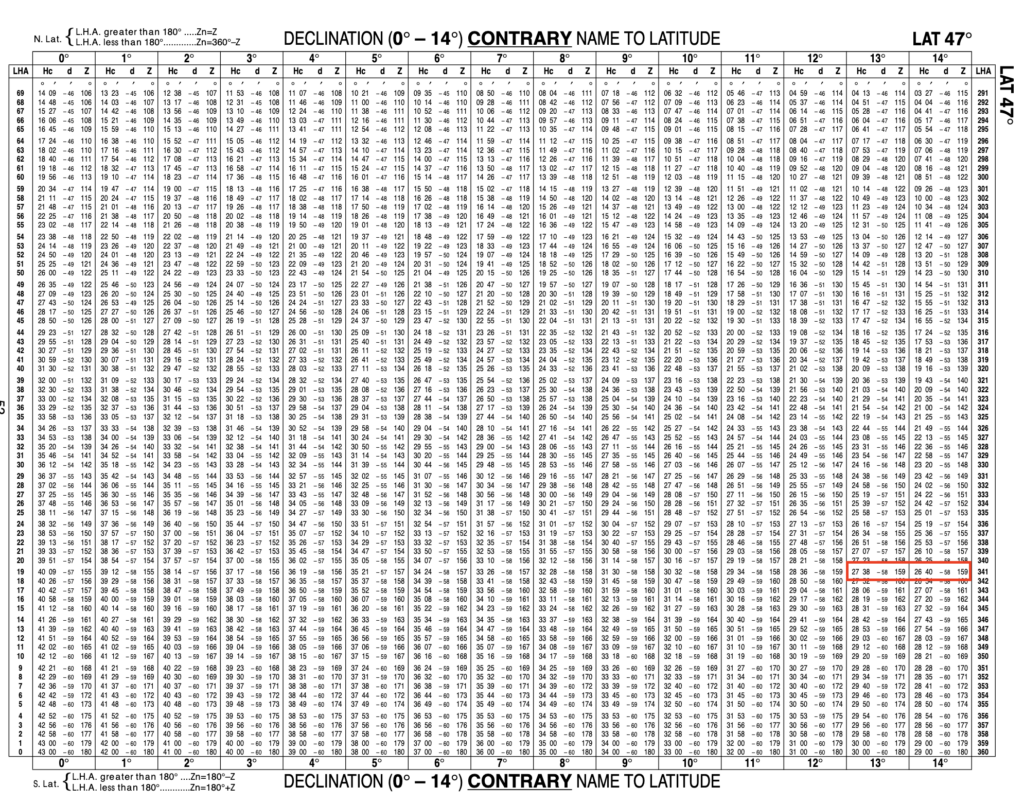
In the almanac, we must therefore find the page corresponding to 47° north latitude, of contrary names, and showing the range of declinations between 0° and 14°. Page 52 of Volume 3 gives us the required information. For 13° of declination, we find H_c =27° 38′ and Z = 159°. For a declination of 14°, we find H_c =26° 40′ and Z = 159°. As the actual declination lies between the two, we must interpolate.
There is a 58-minute difference between the two calculated altitudes. The 32.8 minutes of declination between the two values corresponds to 55% of the difference. Applied to the difference in altitude, we find 32 minutes (58 × 0.55 = 32). Thus, the interpolated calculated altitude is H_c =27° 06′. Z is the same for both columns. Therefore, there is no need to interpolate.
The LHA is 341 degrees and we are in the north, so Z_n = Z = 159°.
The difference between the calculated height and the actual height is 27° 06′ – 26° 45.5’ = 20.5 nautical miles. The direction is away from the celestial body. Therefore, the position line is 20.5 nautical miles from the estimated position 47°N / 60° 35.6′ W in the opposite direction to 159°. The line is perpendicular to this direction.
Exercise 3
At 1532 UTC-3.5, you obtain an observed altitude H_o of the Sun of 19° 12.0’. Your estimated position is 46° 45.5’N / 059° 57.8’ W and the Sun’s GP is GHA 101° 28.1’ / Dec 13° 29.9’S. Identify H_c, Z, Z_n the distance to the estimated position, as well as the direction in which the actual position lies.
Solution
The estimated position becomes 47°N/059° 28.1′ W. The LHA is 42°. The latitude and declination are opposite in sign. We need to find the page in the reduction table that corresponds to this information. Page 52 of Volume 3 corresponds to what we are looking for.
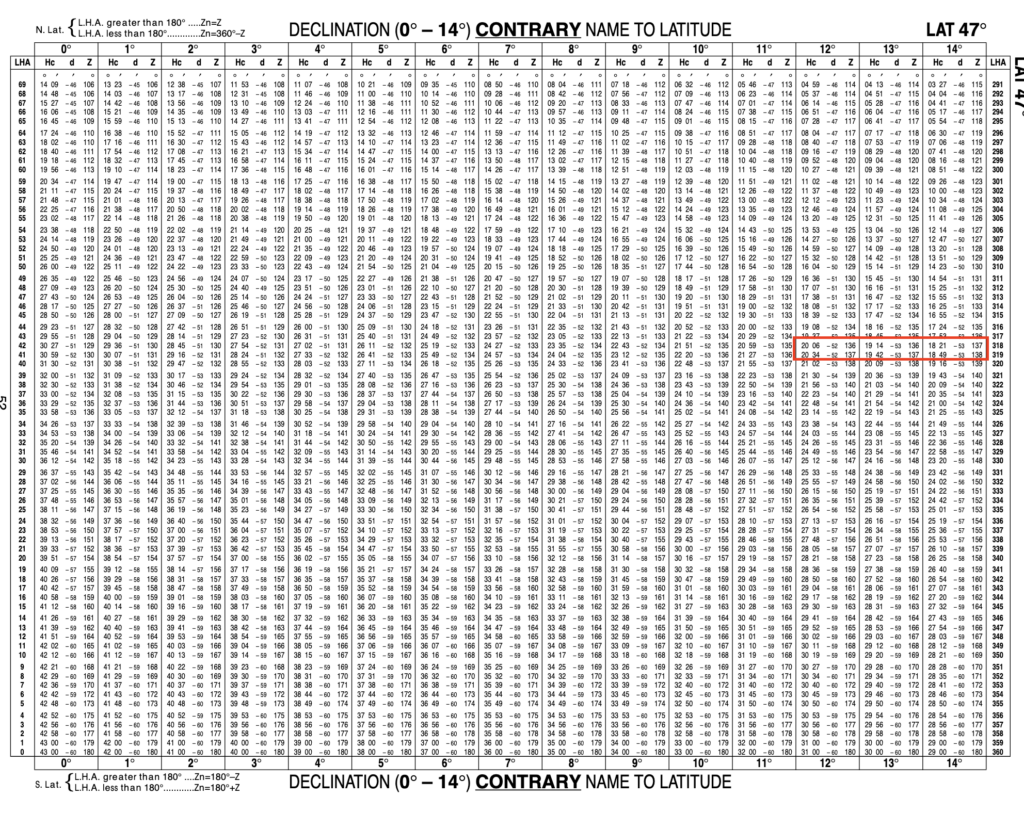
For a declination of 13°, we find H_c =19° 14′ and Z = 136°. For a declination of 14°, we find H_c =18° 21′ and Z = 137°. The declination lies between the two, so we can interpolate by taking half the difference. We therefore have H_c =18° 47.5′ and Z = 136.5°.
Since the LHA is less than 180°, we have Z_n = 360 - Z 223.5°. The calculated height difference is 24.5 nautical miles. As the actual height is greater than the calculated height, the direction to take is towards the GP of the celestial body. The position line is thus 24.5 nautical miles in the direction of 224° from the position 47°N/059° 28.1′ W. The position line is perpendicular to the direction.
Exercise 4
Your estimated position is at 50° 18.7’N / 058° 23.89’W at 1825 UTC-3.5. The observed altitude H_o of the star Rigel is 25° 30.5’. The star’s right ascension is RA 027° 05.1’ / Dec 8° 10.4’S. Identify H_c, Z, Z_n the distance to the estimated position, as well as the direction in which the actual position lies.
Solution
The estimated position becomes 50° N / 058° 05.1’W. The LHA is 329°. The declination and latitude are opposite values. We need to find the page in the table that corresponds to this information. Page 75 of Volume 3 is what we are looking for.
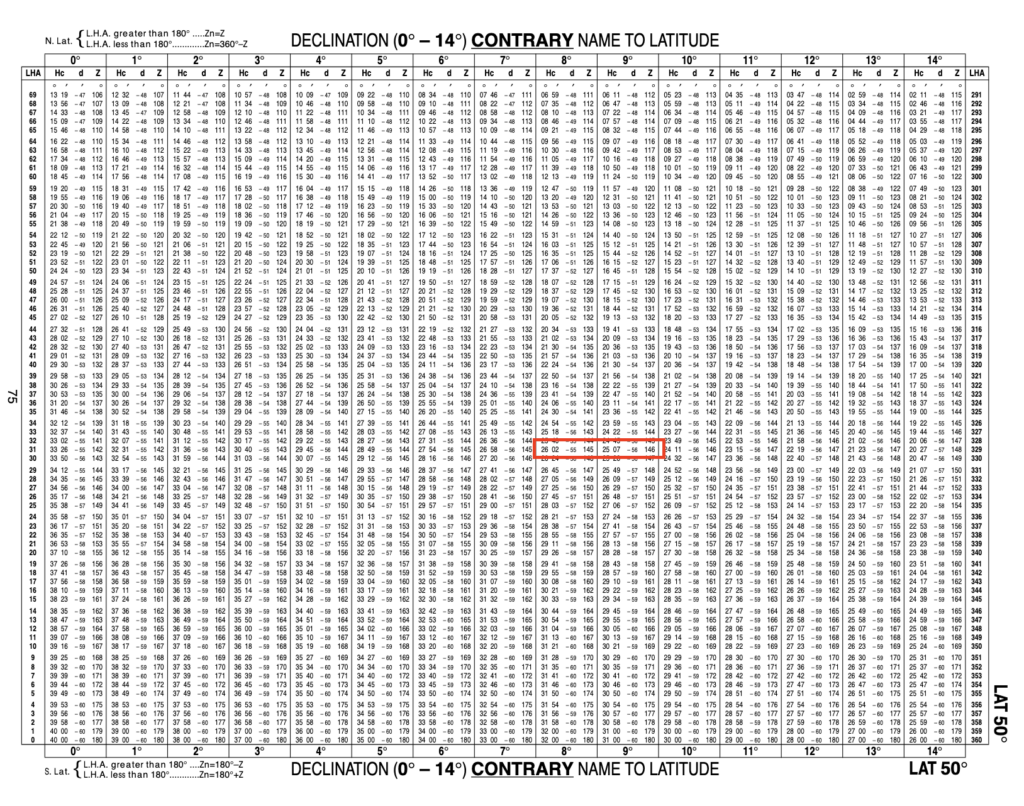
For 8° of declination, we find H_c =26° 02′ and Z = 145°. For a declination of 9°, we find H_c =25° 07′ and Z = 146°. The declination is 8° 10.4′, so we must interpolate by taking 17.3% of the differences. We therefore have H_c =25° 52.5′ and Z = 145° 10′.
As the LHA is greater than 180°, we have Z_n = Z 145°. The calculated height difference is 22 nautical miles. As the actual height is less than the calculated height, the direction to take is in the opposite direction to the GP of the celestial body. The position line is therefore 22 nautical miles in the direction of 325° from the position 50° N / 058° 05.1’W. The position line is perpendicular to this direction.
Exercise 5
Your estimated position is at 50° 18.7’N / 058° 23.89’W at 1825 UTC-3.5. The observed altitude H_o of the star Hamal is 60° 28.8’. The star’s right ascension is GHA 074° 41.0’ / Dec 23° 35.2’N. Identify H_c, Z, Z_n the distance to the estimated position, as well as the direction in which the actual position lies.
Solution
The new estimated position becomes 50° N / 058° 41.1’W. The LHA is 16°. The latitude and declination are of the same sign. We must find the page in the reduction tables that corresponds to these elements. Page 76 of Volume 3 corresponds to our requirements.
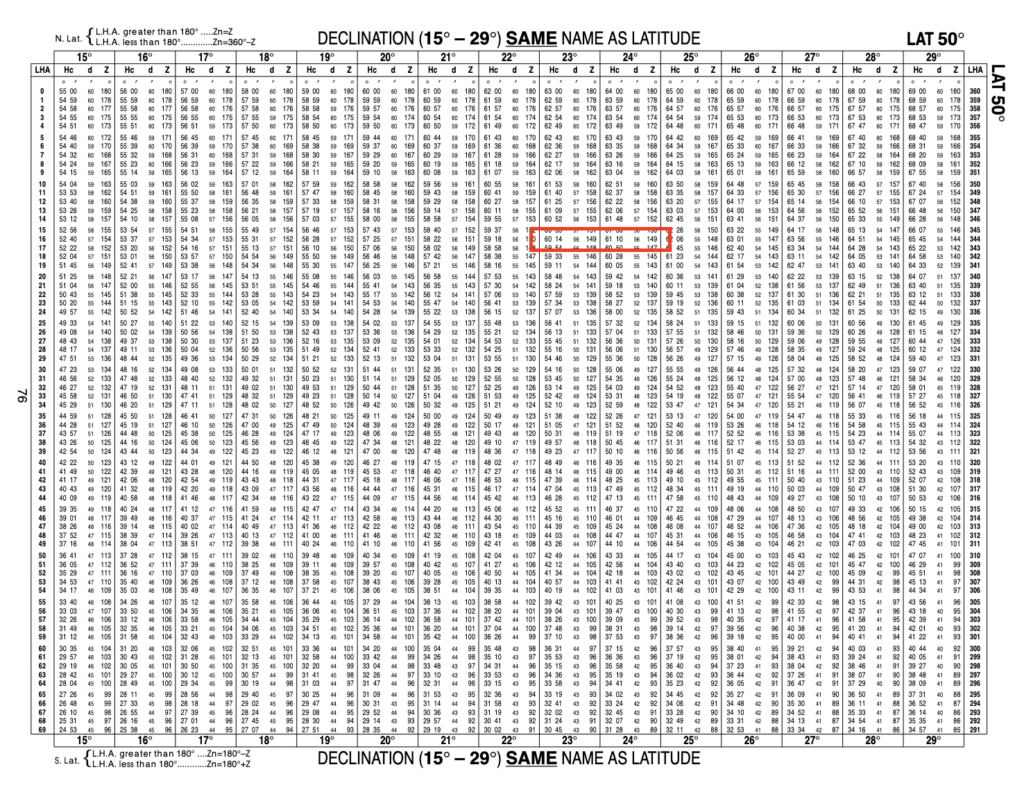
For 23° declination, we find H_c =60° 14′ and Z = 149°. For a declination of 24°, we find H_c =61° 10′ and Z = 149°. The declination is 23° 35.2′, so we must interpolate by taking 58.6% of the differences. We therefore have H_c =60° 46.9′ and Z = 149°.
As the LHA is less than 180°, we have Z_n = 360 - Z = 211°. The calculated height deviation is 18.1 nautical miles. As the actual height is less than the calculated height, the direction to take is in the opposite direction to the GP of the celestial body. The position line is thus 22 nautical miles in the direction 031° from the position 50° N / 058° 41.1’W. The position line is perpendicular to this direction.